Using Omnifocus
Dashboards are just the tip of the iceberg in Creating Flow with OmniFocus. There are many hints and tips for how to deal with recurring tasks, link to external applications like OmniOutliner (something I am leveraging a lot now that the iOS app is universal), setup more custom perspectives. You can’t sometimes use that field to schedule tasks or you will never trust your system again. My two favorite task managers handle this just fine: OmniFocus and my Franklin planner. OmniFocus has a defer date which lets you schedule tasks for a specific date, keeping the due date and the do-it date separate. This is a good start, but it’s. Learn how to use OmniFocus with Getting Things Done to, well get things done!Learn more about OmniFocus at more aboou.
Let’s say you need to return a book to the library by Saturday, May 1. If possible, you’d like to return it a few days early while you’re out running errands. Simple, right?
Most task managers can’t handle this. They only have one way to schedule the task: set a due date on it. But which date do you put down? It’s due on May 1—that’s when you’re going to have consequences if you don’t get it done. But you want to do it on Wednesday, April 28.
Most apps can’t handle this simple scenario. You have one field. You need to know the due date to plan properly. You can’t sometimes use that field to schedule tasks or you will never trust your system again.
My two favorite task managers handle this just fine: OmniFocus and my Franklin planner. OmniFocus has a defer date which lets you schedule tasks for a specific date, keeping the due date and the do-it date separate. This is a good start, but it’s limited.
How do you schedule a task for the week of May 24? Or 2021Q4? Or sometime next April (April 2022)?
Here’s how to configure OmniFocus to schedule tasks as powerfully and flexibly as a Franklin Planner.
How paper scheduling worked
A Franklin planner natively supports scheduling tasks in the following temporal contexts:
- Daily task lists. This is the bread and butter of time management. To schedule something for April 28, just turn to the page for Wednesday, April 28, and write it down. You can do this as far in advance as your current refill goes.
- Weekly Compass. You could schedule big rocks for sharpening your saw and achieving your goals by putting them on your weekly compass. Then, someday? that week, you transferred the task to your daily task list. (This had the extra benefit of keeping your big rocks highly prominent.)
- Master Task List. During your monthly planning, you created a list of tasks you wanted or needed to do this month. Need to do something next month? In three months? Write it on that month’s Master Task List.
There was also space to jot down a few tasks further out, usually 2–3 years in advance, but these were the three most commonly used.
Out of the box, OmniFocus supports the Daily Task List. The Forecast view is a great view for seeing what tasks you have scheduled for specific days. What it lacks, however, is a way to schedule tasks for “the week of May 24”, “May 2021”, or “2021Q3”.
Setting up OmniFocus
OmniFocus usually uses the Context field to track the resource—the person, place, or thing—you need to accomplish the task. The more important resource to schedule, however, is your time.
Until it’s time to do the task, no other resource matters.Colter Reed
If we try to use the defer date to schedule tasks for a week, or a month, or a quarter, it’s just as confusing as using the due date as a do-it date. We’ll run the same risk of confusing ourselves and dropping the ball. (I’ve tried it.)
Instead, let’s use the Context field to plan when we’re going to perform a task. Here are the temporal contexts you’ll want to set up:
- Today
- Tomorrow
- This Week
- Monday
- Tuesday
- Wednesday
- Thursday
- Friday
- Saturday
- Sunday
- This Weekend
- Next Week
- This Month
- Next Month
- 06-June
- 07-July
- 08-August
- 09-September
- 10-October
- 11-November
- 12-December
- 01-January
- 02-February
- 03-March
- 04-April
- 05-May
- This Quarter
- Next Quarter
- Q4–2021
- Q1–2022
- Q2–2022
- Q3–2022
- This Year
- Next Year
- Someday
Only Today is Active. Change the status of the others to On Hold. (Create them first, then select them all and change the status en masse.) Tasks assigned to those contexts aren’t actionable yet.
Note that if it’s currently April, the current month is This Month and May is Next Month. This is why 04-April and 05-May go at the bottom of the list. They represent next April and May—a year from now.
Get Some Perspective
You can now select Contexts from the sidebar (or Perspectives > Contexts from the menu) and see the tasks you have scheduled for Today, This Week, and This Month, but OmniFocus Pro lets you create custom perspectives. We’re going to make custom perspectives for the Daily Task List and Weekly Compass that are a little more powerful than that.
If you star these perspectives in the Perspectives window (Perspectives > Show Perspectives), they’ll appear in the sidebar on macOS. On iOS, you can rearrange them to put them closer to the top for convenient access.
Daily Task List
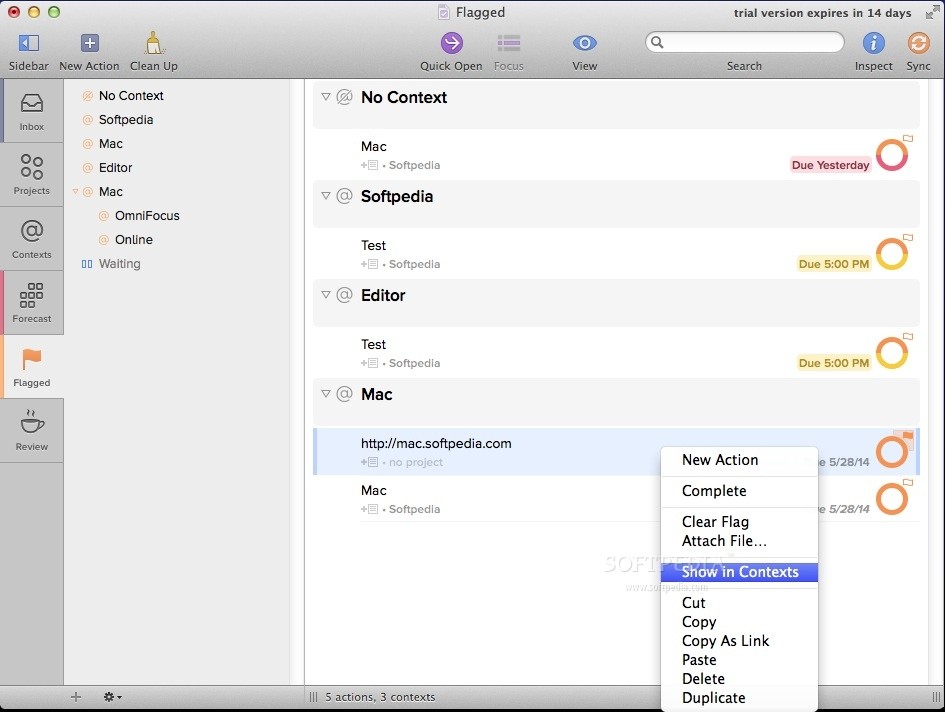
You’re going to spend most of your time executing from the Daily Task List. I call this simply “Today” because it fits in the sidebar better. (It also reminds me these are my tasks for today so I don’t add incoming tasks to it by default.)
- Group actions by: Flagged.
- Sort actions by: Due.
- Filter by availability: Available
- Filter contexts: Active
This groups your flagged tasks at the top. These are your big rocks—your A tasks. They go at the top. (If you want to get a full A1, A2, A3 effect, you can.)
Weekly Compass
It’s helpful to keep an eye on the critical tasks for the week, not just for today. Your weekly compass can guide you through the morass of the week.
- Group actions by: Project
- Sort actions by: Project
- Filter by Status: Flagged
- Filter by Availability: Remaining
- Filter contexts: Remaining
- Sidebar Selection: Today, Tomorrow, This Week
When planning your week, flag the tasks that go on your weekly compass. When planning your day, start here. Fill your day with big rocks before the gravel starts to come in.
The key is not to prioritize your schedule, but to schedule your priorities.Stephen R. Covey
It’s easy to feel overwhelmed by all the gravel that pours in. When you focus on when you’re going to do things instead of the person, place, or tool you’ll need, you can keep your head above the fray. You can see what you already have on your plate. Instead of being buried by one more commitment, you will have the courage and clarity to decline or defer incoming requests.
This setup gives you a more powerful foundation for scheduling tasks in OmniFocus. It really does feel like you’re flipping forward and writing down a task for three months from now without assigning an arbitrary date. Let “July 1” mean July 1. Assign a task to 07-July and when the time comes, you’ll see it again, schedule it for the right day, and get it done.
Question: What tasks do you need to schedule months in advance? Share your thoughts in the comments, on Twitter, LinkedIn, or Facebook.
Never Miss a Post
When you sign up to receive my blog posts by email, you’ll get a FREE copy of The Digital Goal Domination Guide, my new ebook that will show you how to reach your goals using OmniFocus and Evernote. Get more done this year than you ever thought possible!
Using Omnifocus For Gtd
PLUS, you’ll receive occasional bonus content and special offers, some of it not available on the blog.
You’re subscribed! Check your email for instructions on how to download your book.
Update:OmniFocus for the Web is now available, and is a great solution for working with your OmniFocus data on a Windows PC.
While OmniFocus doesn’t offer any direct integration with the Windows platform, and we don’t have any plans to create a client for Windows, many of our Windows customers use our Omni Sync Server’s Mail Drop service to loop their PC into their OmniFocus workflow. By using Mail Drop, you can capture items into the OmniFocus Inbox from any device that supports email.
Using Omnifocus And Omniplan Together
In addition, if you’re utilizing Outlook for Windows and it syncs with Microsoft Exchange, by configuring Exchange on your iOS device you can set up a one-way migration of Outlook Reminders into OmniFocus through our Reminders Capture feature. While this was originally designed around using Siri to dictate tasks into OmniFocus via the Apple Reminders app, this workflow offers the side benefit of allowing any program that can sync to Reminders.app a way to get tasks into OmniFocus for iOS.
iTunes on Windows also backs up the data on your iPhone or iPad when you plug it in, so while this doesn’t give you a way to directly interact with your database from the PC, it’s a great measure to ensure your data is backed up in case something untoward happens. As a measure of redundancy, it might also be worth synchronizing with Omni Sync Server or another WebDAV server, so that you’ll have a live copy of your database living somewhere online in the event that your mobile device is damaged or stolen.
Omnifocus Tutorial
Last Modified: Apr 4, 2019Omnifocus Windows 10
Related Articles