Commas Meaning

The Oxford (or serial) comma is the final comma in a list of things. For example:
Inverted Commas/Quotation Marks: Whether it is for a direct speech or for marking a significant quote, we see inverted commas all the time in written English. Sometimes they can be single styled inverted commas, other times they are the double styled inverted commas. See how to use inverted commas in this article.
Commas with Interrupters or Parenthetical Elements. Interrupters are little thoughts that pop up in the middle of a sentence to show emotion, tone, or emphasis. A parenthetical element is a phrase that adds extra information to the sentence but could be removed without changing the meaning of the sentence. It is important to learn how to use punctuation such as commas in your writing to clarify the meaning of your sentencesUse these Commas KS2 Worksheets to explain to your children how commas can be used to clarify meaning. Adding a comma to a sentence can change the meaning of it entirely.
The Oxford comma comes right after eraser.
Use of the Oxford comma is stylistic, meaning that some style guides demand its use while others don’t. AP Style—the style guide that newspaper reporters adhere to—does not require the use of the Oxford comma. The sentence above written in AP style would look like this:
Unless you’re writing for a particular publication or drafting an essay for school, whether or not you use the Oxford comma is generally up to you. However, omitting it can sometimes cause some strange misunderstandings.
Without the Oxford comma, the sentence above could be interpreted as stating that you love your parents, and your parents are Lady Gaga and Humpty Dumpty. Here’s the same sentence with the Oxford comma:
Those who oppose the Oxford comma argue that rephrasing an already unclear sentence can solve the same problems that using the Oxford comma does. For example:
could be rewritten as:What do you think about Oxford comma? Share your thoughts in the comments!
Can you imagine a paragraph without any periods or commas? In truth, it would be almost unreadable. There are 14 punctuation marks in English grammar, and, at minimum, one of them has to appear in every sentence, never mind every paragraph, to make it easily understood.
The good news is, with fourteen different punctuation marks to choose from, variety will remain the spice of life. Follow these 6 basic punctuation rules and they will help you to write more clearly and effectively.
Single Inverted Commas Meaning
1. Punctuation Must be Parallel
When punctuation is parallel it means that interrupting a main clause with a dash or a comma requires the same punctuation at both the beginning and end of the clause.
- Incorrect: The teenagers, students from Mrs. Smith's art class-went on a field trip to the museum.
- Correct: The teenagers, students from Mrs. Smith's art class, went on a field trip to the museum.
- Correct: The teenagers-students from Mrs. Smith's art class-went on a field trip to the museum.
This rule also means that you should not use a semicolon to set off just one item in a list.
- Incorrect: I have lived in Des Moines, Iowa, Seattle, Washington; and Boise, Idaho.
- Correct: I have lived in Des Moines, Iowa; Seattle, Washington; and Boise, Idaho.
2. An Emdash is a Strong Comma
An emdash (the longest of the three dashes) can be used for many of the same purposes as a comma. A pair of emdashes might be used if the sentence already contains commas. Similarly, it might be used to mark off information for emphasis. An emdash can also act alone, drawing attention to a modifier or an extra piece of information. Here are a few examples:
- Sarah hated walking to school-it was all uphill-but she had no choice, she had missed the bus again.
- For his birthday, Mark received a sweater, a jacket, a savings bond-and a new bike!
- Pizza, chocolate, and ice cream-these are my favorite foods.
3. A Colon Appears at the End of a Main Clause
If you have trouble deciding when to use a colon in your writing, it helps to ask yourself if a period or question mark would be appropriate in the same location. If the sentence is already complete, you may use a colon to add a list, elaboration, or restatement.
- List: I have three brothers: David, Kent, and Jacob.
- Elaboration: I have decided not to move to San Francisco: I have been offered a better job in Milwaukee.
- Restatement: Thinking back, Jenny wasn't sure who started yesterday's fight: she couldn't decide whether she was at fault or her friend Annie.
4. A Semicolon is Used for Equal Emphasis
In a compound sentence that has no coordinating conjunction, a semicolon can join related independent clauses that are of equal importance.
- Sarah answered my question abruptly; she seemed preoccupied.
A semicolon can also be used before a conjunctive adverb joining two clauses in a compound sentence.
- The restaurant was very crowded; however, the waitress took our order immediately.
5. Parentheses Show Related, Nonessential Elements
Parentheses can be used to show elements in a sentence that are related but not necessary to understand the meaning of the sentence. Parentheses can be replaced by commas in most cases, although the use of parentheses tends to de-emphasize a piece of information.
- My family visited several countries (Italy, France, Portugal, and Spain) on our vacation last year.
If the information inside the parentheses forms a complete sentence within the larger sentence, no punctuation is necessary.
- The snow (April saw it when she passed the window) completely covered the trees.
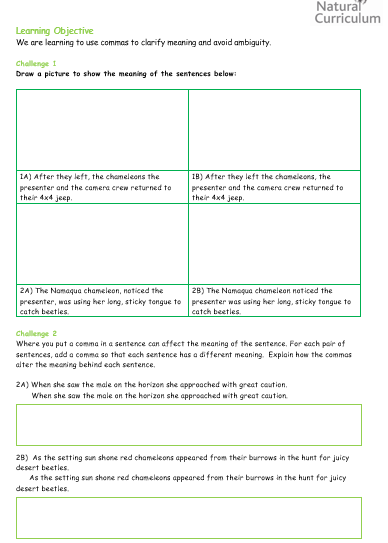
Comma Meaning Example Of Sentence
6. Apostrophes Show Possession or Indicate an Omission
An apostrophe is used to show possession or ownership. An apostrophe and an -s should be added to singular possessive nouns, plural possessive nouns that do not end in -s, and singular possessive nouns that end in -s. Only an apostrophe should be used when showing possession or ownership for a plural possessive noun that ends in -s.
/RulesforUsingComma-5b209d0e1d64040037a65555.png "Meaning")
- Singular possessive noun: Susan's book
- Singular possessive noun ending in -s: Chris's car
- Plural possessive nouns: the children's school
- Plural possessive noun that ends in -s: my parents' house
An apostrophe can also be used to show that a letter has been omitted from a word to form a contraction. For example, 'they're' is a contraction of 'they are' and 'it's' is a contraction of 'it is.' (Note that 'its' is a possessive pronoun.)
Punctuation Rules
Now that you've got the basic punctuation rules under your belt you're ready to tackle your problem areas. Be it commas, semicolons or apostrophes that troubles you, YourDictionary has a wealth of in-depth punctuation knowledge right at your fingertips. Anything you'd like to learn to use more effectively is here for the taking.
So, get excited! Your paragraphs are about to be bulked up with colons, emdashes, and parentheses the likes this world has never seen. Happy writing!
Commas Meaning In Hindi