Authorized Key Ssh

To move the contents of your public key (.ssh ided25519.pub) into a text file called authorizedkeys in.ssh on your server/host. This example uses the Repair-AuthorizedKeyPermissions function in the OpenSSHUtils module which was previously installed on the host in the instructions above. The key fingerprint is: 8c:2a:ed:82:98:6d:12:0a:3a:ba:b2:1c:c0:25:be:5b. Ssh/authorizedkeys to make sure we haven't added extra keys that you weren't. The opensshkeypair module uses ssh-keygen to generate keys and the authorizedkey module adds and removes SSH authorized keys for particular user accounts. The public key is uploaded to a remote server that you want to be able to log into with SSH. The key is added to a special file within the user account you will be logging into called /.ssh/authorizedkeys. When a client attempts to authenticate using SSH keys, the server can test the client on whether they are in possession of the private key. An authorized key in SSH is a public key used for granting login access to users. The authentication mechanism is called public key authentication. Authorized keys are configured separately for each user - usually in the.ssh/authorizedkeys file in the user's home directory.
-->Most authentication in Windows environments is done with a username-password pair.This works well for systems that share a common domain.When working across domains, such as between on-premise and cloud-hosted systems, it becomes vulnerable to brute force intrusions.

By comparison, Linux environments commonly use public-key/private-key pairs to drive authentication which doesn't require the use of guessable passwords.OpenSSH includes tools to help support this, specifically:
- ssh-keygen for generating secure keys
- ssh-agent and ssh-add for securely storing private keys
- scp and sftp to securely copy public key files during initial use of a server
Authorized Key Ssh Code
This document provides an overview of how to use these tools on Windows to begin using key authentication with SSH.If you are unfamiliar with SSH key management, we strongly recommend you review NIST document IR 7966 titled 'Security of Interactive and Automated Access Management Using Secure Shell (SSH).'
About key pairs
Key pairs refer to the public and private key files that are used by certain authentication protocols.
SSH public-key authentication uses asymmetric cryptographic algorithms to generate two key files – one 'private' and the other 'public'. The private key files are the equivalent of a password, and should stay protected under all circumstances. If someone acquires your private key, they can log in as you to any SSH server you have access to. The public key is what is placed on the SSH server, and may be shared without compromising the private key.
When using key authentication with an SSH server, the SSH server and client compare the public keys for username provided against the private key. If the server-side public key cannot be validated against the client-side private key, authentication fails.
Multi-factor authentication may be implemented with key pairs by requiring that a passphrase be supplied when the key pair is generated (see key generation below).During authentication the user is prompted for the passphrase, which is used along with the presence of the private key on the SSH client to authenticate the user.
Host key generation
Public keys have specific ACL requirements that, on Windows, equate to only allowing access to administrators and System.To make this easier,
- The OpenSSHUtils PowerShell module has been created to set the key ACLs properly, and should be installed on the server
- On first use of sshd, the key pair for the host will be automatically generated. If ssh-agent is running, the keys will be automatically added to the local store.
To make key authentication easy with an SSH server, run the following commands from an elevated PowerShell prompt:
Since there is no user associated with the sshd service, the host keys are stored under ProgramDatassh.
User key generation
To use key-based authentication, you first need to generate some public/private key pairs for your client.From PowerShell or cmd, use ssh-keygen to generate some key files.
Setup Authorized Ssh Keys
This should display something like the following (where 'username' is replaced by your user name)
Authorized Key Ssh Login
You can hit Enter to accept the default, or specify a path where you'd like your keys to be generated.At this point, you'll be prompted to use a passphrase to encrypt your private key files.The passphrase works with the key file to provide 2-factor authentication.For this example, we are leaving the passphrase empty.
Now you have a public/private ED25519 key pair(the .pub files are public keys and the rest are private keys):
Remember that private key files are the equivalent of a password should be protected the same way you protect your password.To help with that, use ssh-agent to securely store the private keys within a Windows security context, associated with your Windows login.To do that, start the ssh-agent service as Administrator and use ssh-add to store the private key.
After completing these steps, whenever a private key is needed for authentication from this client, ssh-agent will automatically retrieve the local private key and pass it to your SSH client.
Note
It is strongly recommended that you back up your private key to a secure location,then delete it from the local system, after adding it to ssh-agent.The private key cannot be retrieved from the agent.If you lose access to the private key, you would have to create a new key pairand update the public key on all systems you interact with.
Deploying the public key
To use the user key that was created above, the public key needs to be placed on the server into a text file called authorized_keys under usersusername.ssh.The OpenSSH tools include scp, which is a secure file-transfer utility, to help with this.
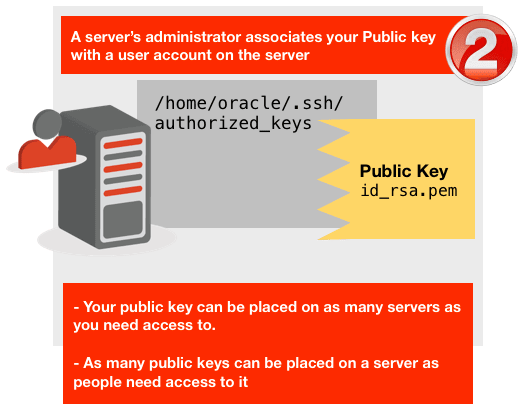
To move the contents of your public key (~.sshid_ed25519.pub) into a text file called authorized_keys in ~.ssh on your server/host.

This example uses the Repair-AuthorizedKeyPermissions function in the OpenSSHUtils module which was previously installed on the host in the instructions above.

These steps complete the configuration required to use key-based authentication with SSH on Windows.After this, the user can connect to the sshd host from any client that has the private key.
SSH keys can restrict, control, and secure access to an ESXi host. An SSH key can allow a trusted user or script to log in to a host without specifying a password.
You can copy the SSH key to the host by using the vifs vSphere CLI command. See Getting Started with vSphere Command-Line Interfaces for information on installing and using the vSphere CLI command set. You can also use HTTPS PUT to copy the SSK key to the host.
Instead of generating the keys externally and uploading them, you can create the keys on the ESXi host and download them. See VMware Knowledge Base article 1002866.
Enabling SSH and adding SSH keys to the host has inherent risks. Weigh the potential risk of exposing a user name and password against the risk of intrusion by a user who has a trusted key.